What Is a Focal Point in Art the Principle of Variety
Use one, some, or all of these vii options for calculation direction and interest—a focal point—to your paintings.
By Tim Saternow
What makes a viewer desire to break in front of i painting and take it all in, yet quickly laissez passer by and dismiss another? Everyone comes from a different indicate of view, and everyone's life experience is unique. If looking at a painting is a journey of insight and contemplation, how can you, as an artist, influence that journeying?
Although you can't really control how—or if—someone will empathize your painting, in that location are techniques available to assist y'all communicate and clarify your particular vision. It's up to you to lead the viewer in seeing and understanding your work. There are many things you tin do to facilitate the opportunity for discovery. Ane of these is creating a strong point of emphasis, or
While a focal point can guide the centre intentionally, leading information technology to the surface area where you lot want the viewer to wait, at that place's a residuum between an obvious focal point and a subtle 1, and the fashion it leads to better clarity of your content. Determining a
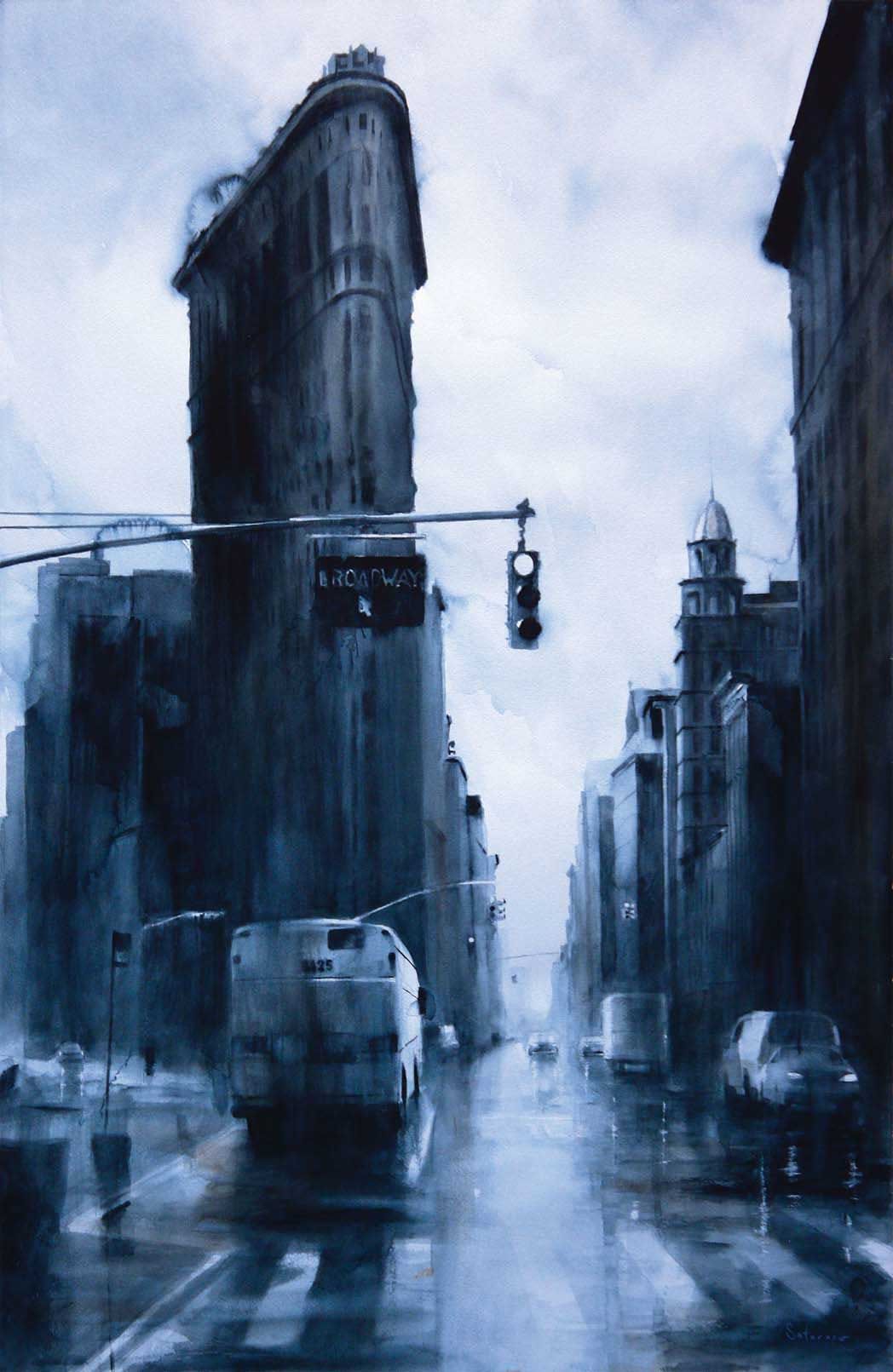
An Emphasis by Dissimilarity
Is there an element in your composition that's unique and different? If so, information technology might serve equally a good
An Emphasis past Colour
Color might be the easiest choice for creating a strong focal indicate. Y'all really tin't look abroad from a red sign, a bright blue umbrella or a yellow tree in early autumn. Keep in mind that different colors draw the middle very differently. Warm colors tend to accelerate, while libation colors recede. This can all change, however, based on the hue or intensity of the focal color, or the colors sitting next to the focal color—specially when they're simultaneously contrasting colors. Just look at any print advertizement to encounter the power of colour in attracting the eye. For instance, chartreuse—that particular shade of yellowish-green institute on fire trucks and worn by crossing guards—is close to the brightest color of the visible spectrum, and the brain perceives this colour before all others.

An Emphasis past Isolation
This is similar to Emphasis by Contrast, but the idea is to single out an object then that information technology volition be noticed.
This is a contrast of location, and it could be the aforementioned kind of element that fills the rest of the painting merely because it'due south isolated, we look at it first. I tend to employ contrasting value and volition isolate a bright window on a dark street or a pocket-sized dark shadow on a sunlit wall. The eye immediately goes to this section, and it's probably the reason I chose this view.
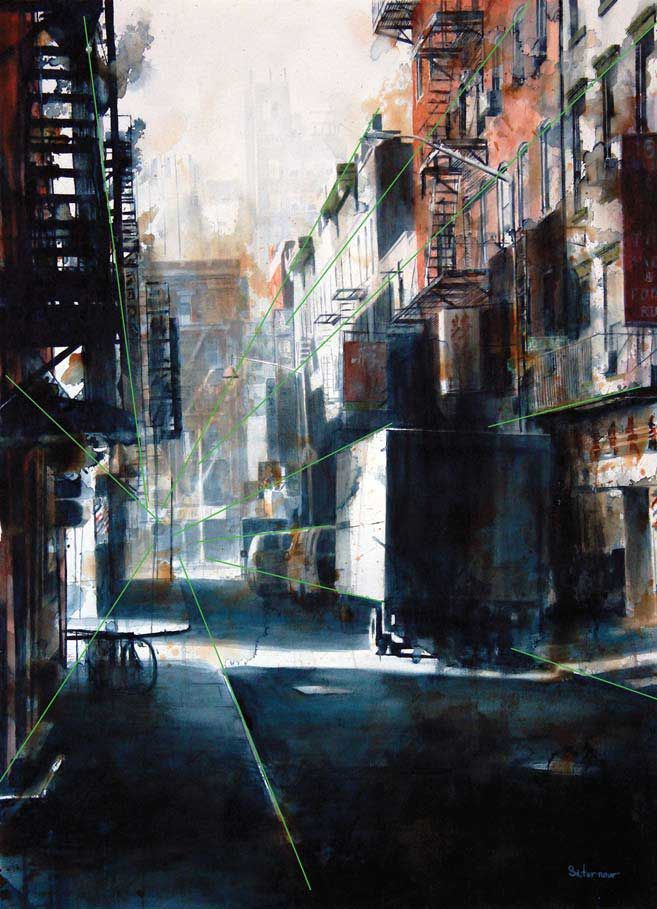
An Emphasis by Placement
The utilise of line, or a line of objects, can direct the center. In my urban landscapes, the natural one-point perspective of a cityscape powerfully leads the eye downwards the street. I tin use telephone wires, the curb, painted traffic lines or the top cornices of buildings as directional lines. These can all bespeak to my particular focal point. All of these lines can be referred to equally radial design or radial residual, similar the spokes of a bicycle cycle, all pointing to a heart focal point. In my urban paintings, I apply all of these street objects and their diagonal energy for convergence to the focal betoken. What's also powerful is the use of an implied, or psychic, line. An implied line is a serial of points that naturally line upwardly, causing the center to connect them. A row of cars, or telephone poles, or a line of windows tin can create this unsaid line right down the street. A psychic line occurs when there's no physical line at all, only a direction is clearly indicated. There'southward a mental connection the viewer creates when the eye is led past a pointing arrow or the gaze of a subject's eyes. You'll look where someone is looking, even though there's no line in that location. Placement as well can refer to the location in the composition at which a
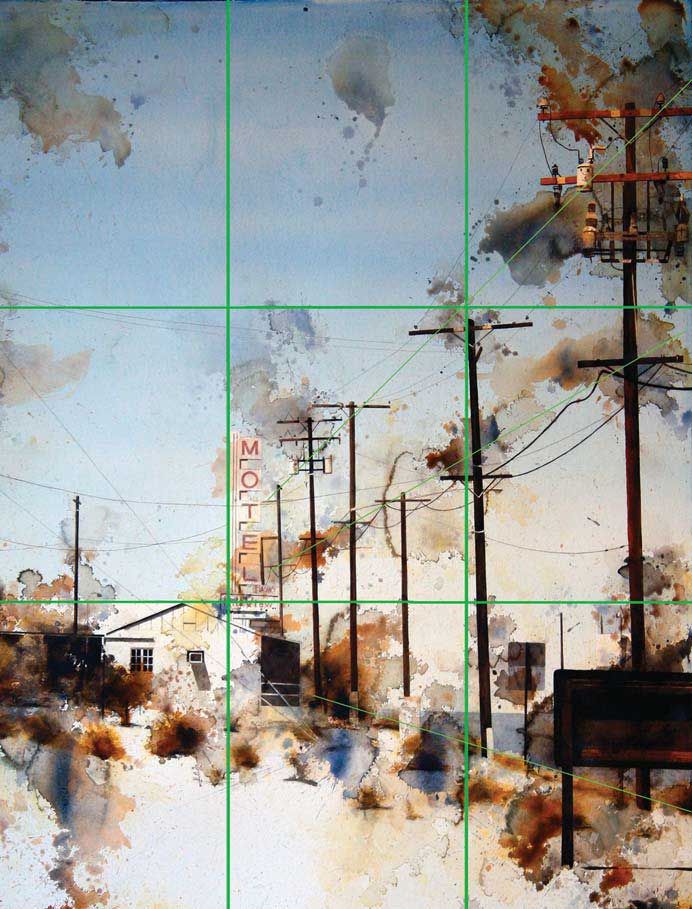
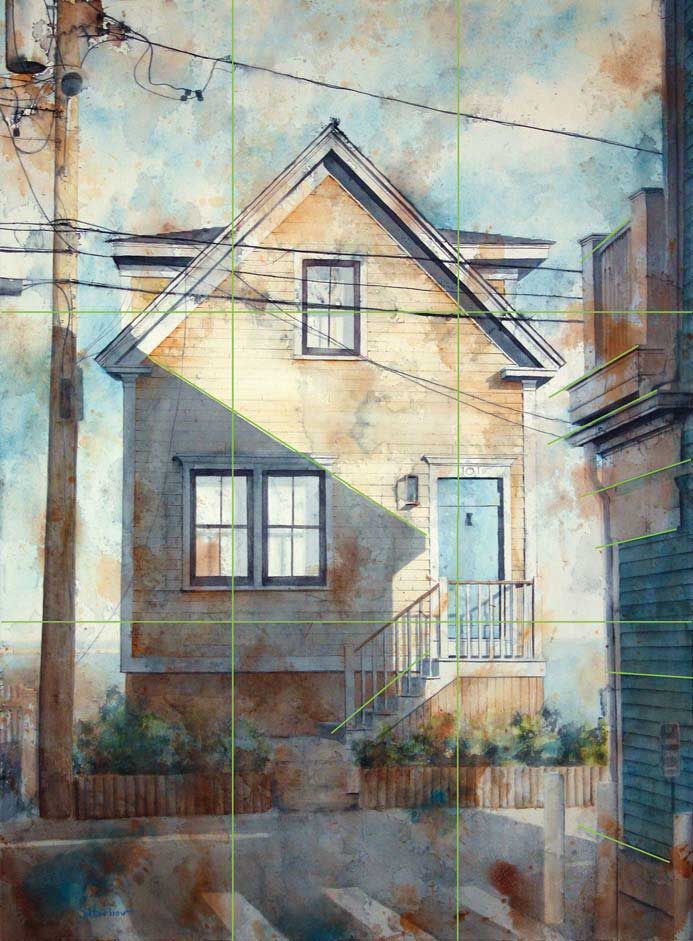
Placement with the use of a frame or framing device is too a very powerful compositional tool. A doorway, window frame, sweep of a tree branch or expanse nether a bridge beautifully frame a focal indicate. A guideline for a strong focal point location is the widely recognized "rule of thirds." If a composition is divided into three equal horizontal parts and three vertical parts (like a tic-tac-toe grid), the intersections at which these lines cross are visually pleasing locations for focal points. The idea is that these are inherently stiff places in a limerick.
An Emphasis by Focus and Depth of Field
This technique became apparent with the appearance of photography. When a foreground element remains sharply in focus while the background goes out of focus, the foreground element becomes the
Accents
Along with a strong point of interest, there can be multiple lesser points, all with varying degrees of emphasis or strength, called accents. These are usually less powerful, but they're important in helping guide the eye around the composition.
An Absenteeism of Focal Point
Lack of a focal signal can pb to confusion, just many artists intentionally omit a single, or ascendant, focal indicate. The idea is to put the emphasis on the unabridged surface for an all-over design. Think of the paintings of American artists Agnes Martin (1912– 2004), Ad Reinhardt (1913–1967) and Jackson Pollock (1912–1956), and you can see how powerful the absence of a focal point tin be. The journeys into these paintings can exist powerful and action-filled or produce a distinct feeling of calm and peace. Hither the absence of a focal betoken is the point.
Expressing Yourself
As artists, the options we take to express ourselves are limitless. The accent on a focal bespeak can change the way our piece of work is seen, besides as how it's felt and understood. Information technology's the choices you make—and where you take the viewer—that brand yous the unique artist you are.
Virtually the Artist
In his large urban watercolors, honor-winning creative person Tim Saternow reveals the fleeting beauty of the onetime factories and gritty streets of New York Urban center. His work has been exhibited in numerous galleries throughout the U.Southward. and internationally. He teaches workshops on painting, drawing and linear perspective in New York City, and in workshops at the Art Students League of New York. His piece of work is represented by the Kobalt Gallery in Provincetown, Mass.
Acquire how Tim gets his signature shades of grayness using a grisaille underpainting.
[divider width="medium"]
This article first appeared in Watercolor Artist.
Source: https://www.artistsnetwork.com/art-techniques/composition/whats-your-focal-point/
0 Response to "What Is a Focal Point in Art the Principle of Variety"
Post a Comment